

This week, Prime Minister Mark Carney and European Commission President Ursula von der Leyen delivered speeches outlining a new partnership between Canada and the EU, although many details still need to be finalized.
Here’s what we have gathered regarding the proposal for Canada to become the EU’s initial “associate member,” a term Carney prefers to frame as “an alliance for the future.”
CBC’s audience has shown considerable interest in this initiative, and the inquiries below mirror some of the questions received in CBC’s inbox over recent days.
- What inquiries do you have regarding the suggested partnership between Canada and the EU? Send them to ask@cbc.ca.
Is Canada looking to join the EU?
Carney has consistently stated that Canada does not intend to become a full member, a stance he has maintained for over a year.
However, during his address to the European Parliament in Strasbourg, France, on Thursday, Carney expressed his support for von der Leyen’s aspiration for Canada to become the EU’s first associate member within the 27-nation bloc.
What does being an ‘associate’ member mean?
The exact meaning remains unclear. “Associate member” is not a formal legal term, although various forms of such a membership have been proposed in the past, including a recent suggestion for Ukraine that did not gain much support.
A senior Canadian official, who spoke to CBC News on the condition of anonymity, indicated that the “associate member” designation is one of several being considered, and that Canada did not initiate the idea.
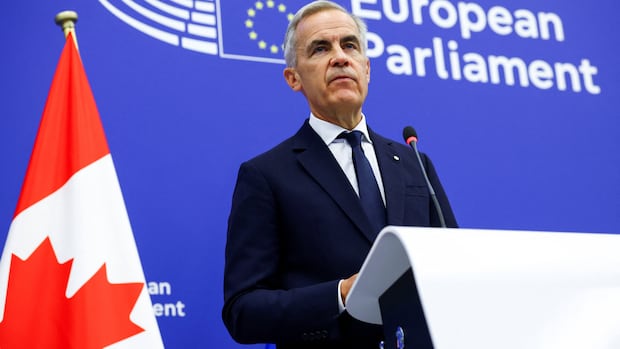
Prime Minister Mark Carney addressed the relationship between Canada and Europe following European Commission President Ursula von der Leyen’s proposal for Canada to become an ‘associate’ member of the EU.
The official noted that they conducted a thorough analysis of the EU’s connections with non-members such as Norway, Switzerland, the U.K., and Georgia, concluding that none would be suitable since the Canadian government aims to retain its independence in exchange for access.
Carney did not elaborate on associate membership in his address, apart from acknowledging von der Leyen’s suggestion.
What specifics were mentioned?
In her address on Wednesday, von der Leyen stated that the EU aims to elevate its relationship with Canada to “the highest level possible.” Although her state of the union speech covered more than just Canada, it briefly highlighted collaborative efforts in areas such as manufacturing, technology, defense, the Arctic, energy, and security.
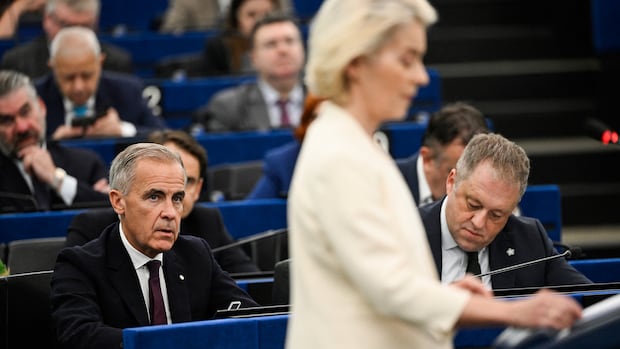
European Commission President Ursula von der Leyen proposed a pathway for Canada to achieve ‘associate membership’ status in the 27-member bloc during Prime Minister Mark Carney’s visit aimed at fostering alliances, although Canadian officials indicate they are not yet prepared to proceed in that direction.
Carney’s address on Thursday outlined several components of his vision for the partnership:
- Collaboration on “critical minerals, defense industrial capacity, AI and computation, energy security, space, and payments.”
- “Seamless, digital” trade in non-agricultural goods and services.
- Involvement in Erasmus+, the EU’s initiative supporting education, training, youth, and sport in Europe, which includes cross-border student exchanges. “Canadian involvement in Erasmus+ can offer your students, and ours, greater opportunities to study at some of the world’s leading universities, broaden their perspectives, and establish enduring connections that will fortify our alliance for the future,” Carney remarked.
- Participation in the next iteration of Horizon, the EU’s funding program for research and innovation. Canada currently enjoys partial access to the existing program, which concludes after 2027.
- Joint efforts on computing capacity, broadband connections, and AI safety protocols.
- Investigation into an integrated market for financial services.
Canada and the EU already share a provisionally applied free trade agreement (CETA), a non-trade Strategic Partnership Agreement, and a Security and Defence Partnership signed in June 2025.
Carney made it clear that he does not envision a joint effort between Canada and the EU aimed at establishing themselves as great-power adversaries. Instead, he aspires for the partnership to serve as a “beacon for other democracies.”
Geneviève Tuts, the EU ambassador to Canada, mentioned that more definitive details are likely to emerge during a Canada-EU summit set for October 29-30 in Montreal.
What remains uncertain?
Several aspects remain unresolved, including what the partnership might be called, what concessions Canada may need to make, if there will be any changes in mobility beyond student exchanges, and — most crucially — whether EU member states and Canada’s Parliament will approve the agreement.
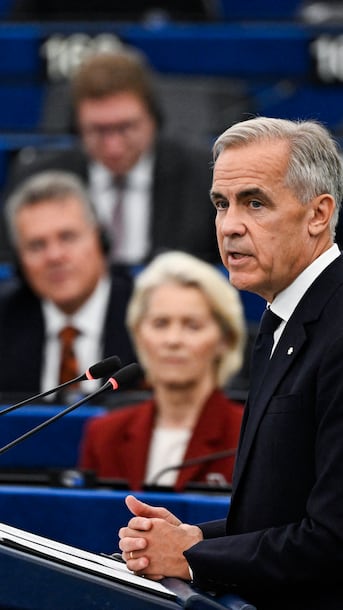
In his speech to the European Parliament, Prime Minister Mark Carney emphasized that a partnership between Canada and the EU would strengthen sovereignty while ‘safeguarding our abilities to live our lives as we choose.’
Carney stated that Parliament will engage in discussions and a vote regarding the framework of any potential alliance with the EU. Some EU diplomats have already expressed concerns about the proposal, indicating it had not been thoroughly discussed with member states, according to reports from Reuters.
There is no indication that von der Leyen is suggesting formalizing the “associate member” status in EU treaties. Achieving that would necessitate unanimous agreement among all 27 countries and ratification domestically, which is highly improbable.
Even the Canada-EU free trade agreement, established nine years ago, is still only active in 17 out of 27 countries.