

Prime Minister Mark Carney responded to U.S. President Donald Trump’s recent remarks, which labeled Canada’s pursuit of a closer relationship with the European Union as “laughable.”
During a press conference on Thursday, Carney stated that an alliance with the EU would enhance Canada’s role as a “better partner” to the U.S., while also affirming that Canadian independence must be respected within that relationship.
In response to Trump’s statements, he remarked, “We are seeking partnerships that complement and strengthen our sovereignty.” He emphasized, “Canadians stand united; no one will dictate our language, culture, or the international agreements we choose to enter.”
Carney, who has been working to strengthen ties with Europe in light of the ongoing trade tensions with the United States, made these comments following his address to the European Parliament in Strasbourg, France, earlier that day.
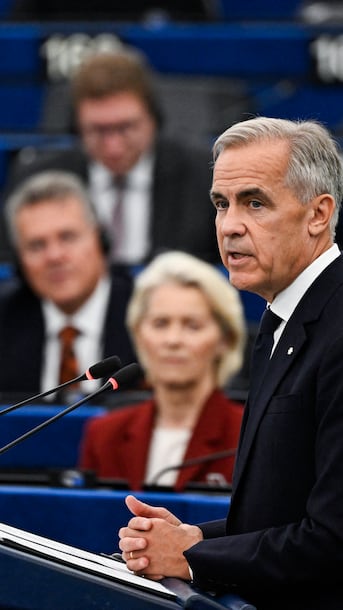
Prime Minister Mark Carney, speaking to the European Parliament, emphasizes that a Canada-EU alliance would bolster sovereignty and “safeguard our ability to live our lives as we choose.”
While the prime minister did not directly mention Trump, he alluded to the U.S. president’s strategies in his remarks. Carney reiterated sentiments he expressed at Davos earlier this year, criticizing the use of economic integration as a tool for leverage and suggesting that Europe could serve as a more dependable ally.
“We are not fair-weather allies. We do not engage in zero-sum negotiations,” he stated. “We share common values that we have always defended, and we must remain vigilant in their protection.”
When questioned about Canada’s efforts to strengthen its partnership with the EU on Wednesday, Trump dismissed the notion as “laughable,” additionally threatening the EU with “very serious tariffs” if it were to enter into a trade agreement with Canada “with bad intentions.”
As Carney began his address, German politician Siegbert Droese, from the far-right Alternative for Germany, chanted “U.S.A., U.S.A.!” eliciting laughter from Carney and boos from others in attendance.
In a statement to CBC News, Droese explained that his chant was meant to highlight the significant role of the U.S. in Europe’s trade landscape.
“It was an absurd and unrealistic reaction for Ms. von der Leyen to suggest an ‘associate EU membership’ for Canada, a status not defined in any European treaties,” he commented. “I admire the American people, just as I do the Canadians.”

U.S. President Donald Trump warned the European Union of “very serious tariffs” or a complete halt in trade if it were to pursue a deal with Canada “with bad intentions.”
Carney advocated for a “future alliance” between Canada and the 27 nations comprising the European Union.
“Together, Canada and the European Union can ground our values and create a protective environment for our citizens to flourish,” he declared.
“This is about sovereignty, our right to live as we choose. It encompasses the freedoms we must defend daily. Sovereignty demands resilience — the capacity to withstand challenges.”
-
Insights on the proposed partnership between Canada and the EU
-
Q&A
Stéphane Dion: Canada is ‘the most European of non-European countries’
In his address, Carney criticized Trump and other dominant powers, asserting that a partnership between Canada and the EU would serve as a “beacon for other democracies.”
“I want to clarify what I am not advocating. I am not advocating for the formation of a third bloc to act as a great-power rival with better manners,” he explained.
“We do not seek dominance over others. Instead, we aim for resilience to ensure no one can manipulate our open markets, compromise our sovereignty, endanger our territorial integrity, or undermine our freedoms, democracies, and the rule of law.”
Over the past year, Canada has established several new partnership agreements with the EU and was the first non-European nation to join Security Action for Europe (SAFE), which allocates €150 billion in loans for defense expenditures.
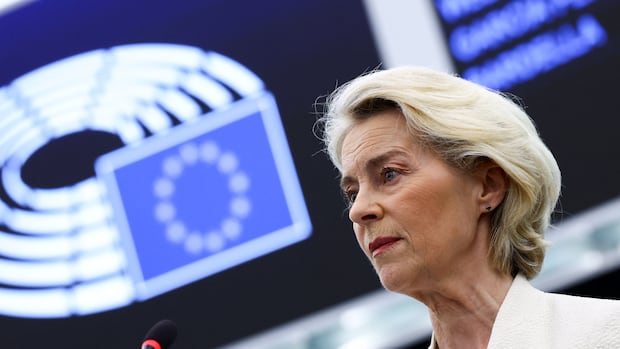
European Commission President Ursula von der Leyen emphasizes the importance of the Canada-Europe relationship, stating, ‘This is not a partnership against anyone else, but for our common strength.’
Strengthening people-to-people connections
In his address, Carney suggested Canada consider joining Erasmus+, the EU initiative that supports education, training, youth, and sport. He also proposed that Canada expand its engagement with Horizon Europe, the EU program that funds various research and innovation initiatives, which has a budget of approximately $150 billion for 2021-2027.
“We should enhance our people-to-people connections, enabling our youth to live, work, and study wherever they choose on either side of the Atlantic,” he stated.
Carney’s remarks followed European Commission President Ursula von der Leyen’s announcement in her state of the European Union address on Wednesday, indicating that Canada could become an “associate member” of the EU.
“I would like to collaborate with you to pave the way for Canada to be the first associate member of the EU,” von der Leyen said, earning a standing ovation.
- What inquiries do you have regarding the proposed Canada-EU partnership? Send them to ask@cbc.ca.
Afterward, Carney acknowledged von der Leyen, approached her, and embraced her, briefly waving to the assembly before returning to his seat.
The EU chief urged the need to “urgently reimagine” their partnership and to evolve beyond merely a free trade agreement.
Carney expressed his support for that ambition but preferred to term it an “alliance for the future.”
“Canada and Europe must secure our strategic autonomy through extensive cooperation across a wide array of strategic capabilities,” he asserted.

Prime Minister Mark Carney indicates that Parliament will discuss and vote on the framework of the alliance with the European Union, presenting this as an opportunity for Canada to enhance its strength, sovereignty, and sustainability.
Prioritizing substance over terminology: Carney
Carney and his administration have been downplaying the usage of “associate member” to define a new partnership since it was initially proposed in a report by the Wall Street Journal last week, referencing unnamed sources.
When questioned on Thursday about the concept of Canada becoming an “associate member,” Carney emphasized that the “substance” of the agreement holds greater significance than its label.
The prime minister clarified that Canada does not aim for full EU membership, and that the ultimate agreement regarding the alliance will be subject to parliamentary debate and vote in Canada.
Jonathan Wilkinson, the incoming Canadian ambassador to the EU, reiterated on Wednesday that Canada does not seek full EU membership, in response to von der Leyen’s speech.

Jonathan Wilkinson, Canada’s new ambassador to the EU, emphasizes that the focus is on ‘results’ rather than the concept of associate membership, stating, ‘What we’re focused on is actually driving results.’
Carney remarked, “There are numerous terms that people have employed to characterize what this [new relationship] could entail. We need to arrive at a point where we have clarity on what we are defining.”
“It’s just terminology; ultimately, there are various ways to describe it,” he added.
Carney met with von der Leyen on Wednesday to discuss areas where both leaders believe they can strengthen collaboration, including critical minerals, AI, defense, energy, and finance.