

Five caribou that were bred in captivity have now been released to roam freely in the Tonquin Valley of Jasper National Park, mingling with wild caribou.
These animals were raised at North America’s first caribou conservation breeding facility, which is operated by Parks Canada with the aim of enhancing the local caribou population.
Over the past two years, Parks Canada has captured wild caribou and transported them to a breeding center located 35 kilometers south of the Jasper townsite. In June, the federal agency announced its first release of caribou, which included four male yearlings born in captivity and one adult male from the Brazeau herd brought in for breeding.
Jean-Francois Bisaillon, the program manager for the Caribou Recovery Program, expressed that witnessing the animals enter the backcountry on June 24 was a profoundly emotional moment for the staff and a significant achievement for caribou conservation.
“Seeing the entire concept come to fruition is incredibly rewarding,” Bisaillon remarked.
Caribou populations in Canada have been classified as at risk for over two decades, primarily due to habitat fragmentation and increased predation by wolves, which is exacerbated by industrial development.
The initiative by Parks Canada was established more than ten years ago to avert local extinction in the Rocky Mountains.
Currently, there are only 50 wild caribou remaining in the Jasper-Banff local population unit, which includes the region south of Highway 16 in Jasper National Park and all of Banff National Park, with just 11 of those being reproducing females.
Bisaillon indicated that when a caribou group has fewer than 10 reproducing females, it cannot sustain itself.
“We are right at that critical point,” stated Bisaillon. “This is precisely why this project holds such importance.”
Preparation for the Release
In March 2025, staff from Parks Canada captured 10 wild caribou, including seven pregnant females, from Jasper National Park and transported them to the breeding center.
Later that same year, seven healthy calves were born, and an orphan caribou from British Columbia was also introduced to the facility. In March 2026, an additional six wild caribou were captured and added to the breeding population.

June marked a significant milestone as it was the first instance of caribou leaving the breeding center to join their wild counterparts in Jasper National Park.
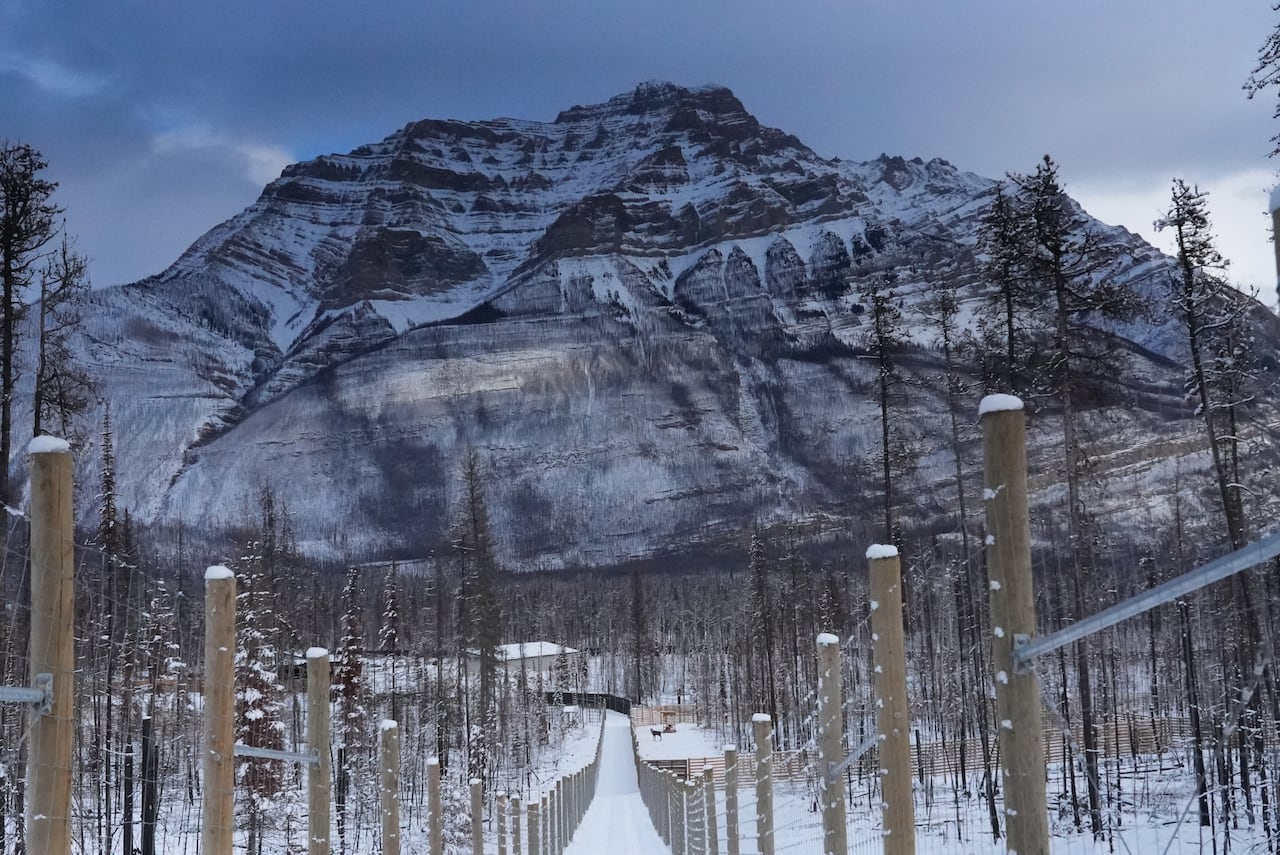
The five male caribou were sedated and flown by helicopter on June 10 to a temporary soft-release enclosure near Amethyst Lake, as stated by Bisaillon. They transitioned from a diet of pellets to natural food sources, such as lichen, while acclimating to the boulder fields and flowing streams of their new environment.
After a two-week period, Bisaillon and the team felt confident that the caribou were ready to fully integrate into the wild. Remarkably, within an hour after opening the gates, all the caribou exited the pen.

The transitional soft-release pen near Amethyst Lake in the Tonquin Valley, Jasper National Park. (Lalenia Neufeld/Parks Canada)
The timing of the release was aligned with the movement patterns of the local wild caribou. GPS collar data indicated that the captive caribou were drawn towards the wild herd, and within days, they began traveling together.
“Caribou are social creatures, so we anticipated that the wild herd would accept the released animals – and now we can confirm that,” remarked Bisaillon.
“Mission accomplished.”
The female calves that were born in captivity will remain at the breeding center to bolster the breeding herd. This will enable the captive caribou to produce more offspring that can eventually be released back into the wild.
A solitary male is seen at the Caribou Conservation Breeding Centre in Jasper National Park. (Maggie Kirk/CBC)
The primary goal of the program is to increase the Tonquin herd to 200 over the next decade, after which they will reassess the possibility of reintroducing the Brazeau and Maligne herds.
Wolf Predation
According to Mark Boyce, an ecologist at the University of Alberta, the decline of caribou in Alberta is closely linked to the forestry and oil industries, which he argues disrupt the natural ecosystem.
“We are not only destroying their winter habitats—where they feed on lichen and seek shelter—but we are also creating ideal environments for deer, elk, and moose,” Boyce explained.
The increase in these prey species leads to a corresponding rise in wolf populations, which also hunt caribou, Boyce noted.
While Jasper National Park is safeguarded from logging and oil extraction, Bisaillon highlighted that wolf populations are the primary reason for the decrease in caribou numbers within the park.
Bisaillon cautioned that the damage inflicted by the 2024 Jasper wildfires could potentially elevate wolf populations, as the burn areas encourage grass growth, which is conducive to deer and elk grazing.
“Our aim is for the entire ecosystem to function independently of human interference,” stated Bisaillon. “That is our ultimate objective.”