

On Wednesday, U.S. President Donald Trump signed a presidential memorandum aimed at pinpointing Canadian goods in federal civil government procurement processes and initiating their removal, according to the White House.
This decision follows a week after Trump prohibited the importation of Canadian alcoholic beverages, motorcycles, and various other items into the United States as part of the escalating trade conflict.
In the memorandum, Trump instructs the U.S. Trade Representative and the Office of Management and Budget to “take steps” to identify Canadian-origin items that might be “removed or made non-available for purchase” within the federal procurement framework.
While the memo does not seem to mandate an immediate ban on the acquisition of Canadian products by government agencies, it could pave the way for future restrictions.
The White House has not yet responded to a CBC News inquiry regarding the potential value of goods that might be impacted by this action.
According to Eric Miller, a Canada-U.S. trade expert, the U.S. government has typically procured around $1.6 billion USD of Canadian goods each year since 2021, based on his evaluation of available spending data.
Miller, who heads Rideau Potomac Strategy Group, suggests that Trump’s memorandum seems to be a response to certain Canadian provinces imposing limitations on U.S. businesses bidding for government contracts.
“The U.S. sees this as an effort to level the playing field in light of the restrictions that Canadian provinces have enacted,” Miller stated in an interview with CBC News.

How can Canada win a trade war with the U.S. when leverage isn’t equal? Andrew Chang explains how Canada is retaliating against massive tariffs levied by a neighbour 13 times its economic size.
(Photo credits: The Canadian Press, Reuters, Adobe Stock and Getty Images)
Additionally, the memorandum instructs the U.S. trade representative to oversee Canada’s handling of U.S. origin goods in Canadian government procurement.
-
Podcast
Canada stood its ground on trade with the U.S. What happens when the cost hits home?
-
U.S. Federal Reserve raises interest rates for 1st time in 3 years
The most recent round of U.S. tariffs on Canadian goods commenced just after midnight on Tuesday, imposing a 50 percent levy on over 100 products, including certain cheeses, motorboats, all-terrain vehicles (ATVs), and various furniture items.
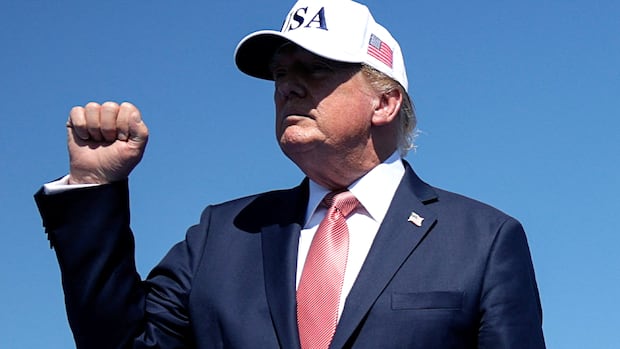
U.S. President Donald Trump hit back at Canada’s counter-tariffs with stiff new tariffs on billions of dollars in some products, and outright bans on others, including alcohol.
The escalating trade conflict intensified in recent weeks following the failure of the U.S. and Canada to finalize a trade agreement in August.
On August 22, the United States implemented a 50 percent tariff on a broad range of Canadian goods as promised. In response, Canada imposed its own tariffs on nearly 700 categories of U.S. products, effective September 8.