

As Canada and the EU strengthen their relationship, Prime Minister Mark Carney expressed a keen interest in participating in Erasmus+, a well-known European exchange initiative.
Although several aspects of the proposed partnership are still to be finalized — such as the implications of Canada becoming the EU’s first “associate member” — Carney highlighted the potential for Canadian engagement in Erasmus+ during his address at the European Parliament in Strasbourg, France, on Thursday.
“By joining Erasmus+, Canadian students could gain opportunities to study at some of the world’s leading universities, expand their perspectives, and forge enduring connections that will support our alliance in the future,” Carney stated.
Carney made it clear that Canada does not aspire to full EU membership and that the new partnership would operate under a different set of guidelines.
He also expressed a desire to engage with the next phase of Horizon, Europe’s research and innovation funding initiative, in which Canada is already a participant. The ongoing Horizon framework for 2021-2027 boasts over $140 billion in funding.
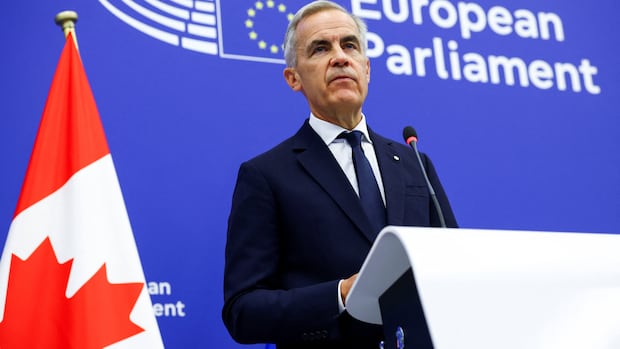
Prime Minister Mark Carney spoke about Canada-Europe relations a day after European Commission President Ursula von der Leyen indicated the possibility of Canada becoming an ‘associate’ member of the EU.
In a conversation with reporters alongside Carney, European Parliament President Roberta Metsola expressed optimism about new opportunities for collaboration with partners like Canada.
“If you ask our youth what they associate with the European Union, I assure you that Erasmus is the first thing they mention,” Metsola remarked. “Horizon follows closely as the second opportunity that could greatly expand with Canada’s involvement.”
“Imagine the possibilities for young individuals in Europe and Canada to study within our two regions, to live and work there, to learn from one another, and to cultivate the relationships that will enhance our connections,” Carney added.
While specifics regarding Canada’s participation in Erasmus+ remain vague, the recent agreement by the U.K. to join the exchange program may provide a useful model, given its non-EU status.
The U.K. established a temporary arrangement to participate in Erasmus+ in April. This agreement is currently set for one year, during which the U.K. is anticipated to contribute 570 million pounds (over $1 billion Cdn) to the program by 2027.
What is the exchange program?

In his address at the European Parliament, Prime Minister Mark Carney noted that Canadian participation in the EU’s student exchange program, Erasmus+, would allow students to ‘expand their perspectives’ and create enduring connections to fortify the partnership between Canada and Europe.
Originally established in 1987 as Erasmus, the flagship EU initiative enables individuals to study and train at educational institutions across Europe for a duration of up to one year.
Initially focused on university exchanges, the program has since broadened to include opportunities for work experience, apprenticeships, and sports.
-
What we know about the proposed partnership between Canada and the EU
-
European Parliament to open Ottawa office as Carney seeks ‘unique alliance’ with EU
Since its inception, over 16 million individuals have participated in the program, as reported by the program’s 2024 report.
In 2014, the initiative was revamped under the new name Erasmus+, incorporating a variety of separate projects and expanding into new fields such as European competence and sports, with €14.7 billion (over $23 billion Cdn) allocated by the EU for the period from 2014 to 2020.
- What questions do you have about the proposed partnership between Canada and the EU? Send them to ask@cbc.ca.
The EU’s budget is derived from contributions made by member states, which are determined by their respective gross national incomes.
For the current funding cycle of 2021-2027, the program’s total budget has increased to an estimated €28.5 billion — approximately $45 billion Cdn — as reported in its 2024 review.
According to the report, 60 percent of the budget is dedicated to supporting learning mobility. The remainder of the funds is allocated to other objectives, including cooperation projects and policy development initiatives.
Erasmus+ encompasses all 27 EU member countries, along with Norway, Iceland, Liechtenstein, Serbia, Turkey, North Macedonia, and the U.K.
Tag: rewrite-pending